

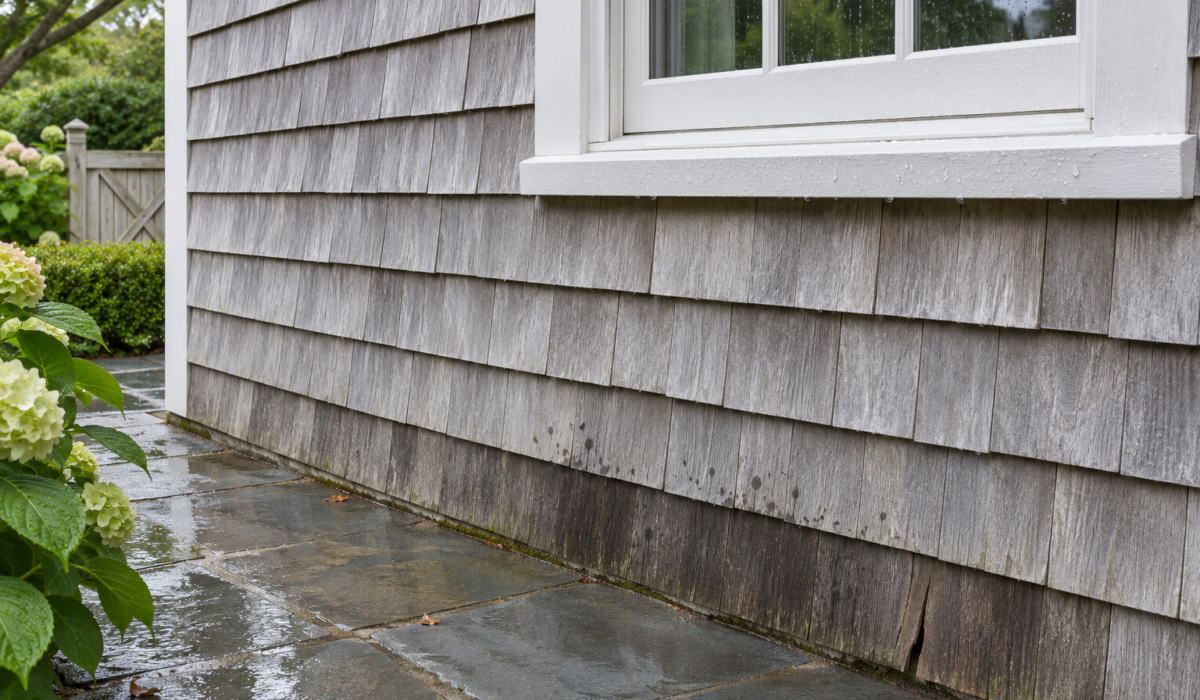
After rain, the cedar beside your walkway turns nearly black. By afternoon, most of the wall has dried back to silver, but a dark band remains along the bottom. Look closer and you might see specks of mud, a curled edge, or a split running up from the end of one shingle. Does that row need replacing?
Color alone tells you little about how much siding needs repair. For a Sag Harbor homeowner, the more useful clues are where the dark area begins, how long it stays wet compared with the cedar beside it, and whether the wood has lost its shape or started to break away. A sound shingle that darkens when wet calls for a different response than a row with missing corners beneath an overflowing gutter. Here’s how to tell what deserves a closer look before you order new cedar.
Read the pattern along the wall
Start a few steps back, far enough to see the window, roof edge, walkway, and planting bed in the same view. A close-up shows the condition of one shingle. The wider view often explains why that particular shingle keeps getting wet.
Suppose the dark band follows the bluestone path for ten feet and ends exactly where the path meets a planting bed. Watch that transition during the next rain. Drops hitting the hard surface may be throwing water back onto the wood. Now consider a different pattern: the bottom row is dark in one narrow patch, and a streak runs down from the corner of a window above it. In that case, ask the contractor to inspect the window detail as well as the lower shingles. Replacing the visibly worn pieces at ground level would leave an important question unanswered.
Take one photo while the wall is wet and another from the same position after the surrounding siding dries. Include a recognizable feature, such as the edge of a step, in both frames. You’ll be able to show exactly which section stays damp even if the contractor visits on a sunny morning.
Check what changed beside the cedar
Think back to the last time you remember that wall looking sound. Was the path reset? Did someone top up the mulch, move a sprinkler, or put a large planter against the house? A change of a few inches beside the wall can explain why a problem appeared after years of ordinary weathering.
At a planting bed, look sideways along the bottom edge. Can you still see where the wood ends, or does it disappear into mulch? Beside a walkway, look for a low spot where a puddle remains against the house. If an irrigation head is nearby, watch one full cycle. A sprinkler that catches just three or four shingles each morning can leave a surprisingly distinct patch, especially beneath a deep eave where the rest of the wall rarely gets wet.
Then look up from the same spot. During rain, you may see water spilling over one end of the gutter or escaping at a joint directly above the marks. Note where it lands and how far it splashes. If you see overflow, include that detail when arranging the inspection so the contractor can consider the roof runoff and the siding together. Golden Hands gutter services. goldenhandsny.com
Which signs point toward cedar siding repair?
Walk along the wall on a dry day and compare the suspect area with a section of the same age. Look at the edges and the joints. A silver-gray shingle can still lie flat, overlap the course beneath it, and have a clean lower edge. A broken corner or a piece that pulls away from the wall changes how that area sheds rain. Wood-shingle siding depends on the way the courses overlap and the joints are staggered. The USDA Forest Products Laboratory illustrates these details in its guide to wood shake and shingle siding. US Forest Service Research and Development
These observations are worth passing along when you call:
- A piece is missing. Photograph the opening and the row directly above it so the contractor can see how the joints line up.
- The lower edges are breaking apart. Note how many neighboring shingles are affected and whether the damage follows the grade or stops at a corner.
- An old patch has failed in the same spot. Find the earlier estimate or a photo if you have one. It may show which pieces were replaced and whether anyone addressed the water source.
- An indoor mark appeared after the same storm. Mention its position relative to the outside damage. A damp baseboard below a window gives the inspector another place to investigate.
Leave the shingles in place for the inspection. Pulling off a loose piece can disturb the course above it, and the original position may help the contractor understand how the opening developed.
Can you replace just the bottom row of shingles?
Sometimes a small patch is a sensible choice. Imagine that a wheelbarrow clipped two shingles beside the driveway. The break is recent, the surrounding pieces sit flat, and the wall dries evenly after rain. That gives a contractor a specific area to open and a plausible explanation for the damage. Ask how the replacement pieces will fit into the existing courses and whether the quote includes any sound shingles that must be lifted or removed to reach them.
The decision changes when a whole run of cedar is deteriorating along a raised patio. Before agreeing to replace that row, ask the contractor to show you where the new lower edge will sit in relation to the stone. If the proposed repair puts fresh wood back into the same wet spot, ask what change to the patio edge, drainage, or wall detail would give the replacement a better chance to dry.
There is also a practical boundary to a small repair. A contractor can estimate the visible work in advance, but the condition of the material directly behind the shingles may only become clear once a few pieces come off. Agree on what happens at that point. For example, you can ask for a photograph of the opened section and a separate price for additional work before the opening is enlarged.
Match the new cedar to the part of the house you actually see
A patch beside the front steps is at eye level for someone coming up the walk. A patch behind a planting bed may be visible only from the driveway. Decide how closely you want the repair to blend from those everyday viewpoints. That decision affects whether it makes sense to replace two individual shingles, a short run, or a section ending at a natural break such as corner trim.
Ask to see a sample held against the wall outdoors. Compare the width of the pieces, the texture of the face, the thickness of the lower edge, and the height of wood visible between rows. That visible height is called the exposure. Even a close color match can look out of place if the replacement row interrupts the horizontal lines across the wall. For an unfinished cedar exterior, ask what difference in color to expect when the work is finished. Fresh wood and years-old cedar can look quite different side by side. cedarbureau.org
If your property is in the Village of Sag Harbor, check its location on the village’s historic district map before settling on a change of siding material or appearance. The village publishes the district boundaries, a contributing-resource list, and its certificate of appropriateness application. Have the street address, a photo, and a brief description of the proposed work ready when asking which review applies to your property. Village of Sag Harbor historic preservation resources. Sag Harbor, NY
What should a cedar siding estimate include?
Two estimates for “repair lower siding” can describe quite different jobs. One might cover the three broken shingles you pointed out. The other might include opening the corner, checking the backing, and correcting a downspout that empties onto the path. Before comparing totals, ask each contractor to mark the limits of the work on the same photo.
A useful written estimate identifies the section to be opened, the replacement cedar and finish, and who will handle any related drainage or trim work. It should also explain how you’ll be notified if the contractor finds deteriorated material behind the siding. If one price is higher, those details let you see whether you’re paying for more work, a closer finish match, or an allowance the other estimate leaves out.
Keep the marked photo after the job. During the next steady rain, stand in the same place and watch where the water lands. A new cedar patch may take time to blend in, but you can often see immediately whether a corrected downspout now carries water past the walkway or a sprinkler still hits the repaired corner.
Request a siding inspection in Sag Harbor
If the bottom shingles on your Sag Harbor home are splitting, coming loose, or repeatedly staying wet in the same place, contact Golden Hands Construction at (631) 877-8338. Have one wide photo of the wall and one close-up of the damage ready. A detail as simple as “the dark strip ends where the bluestone ends” gives the contractor a better starting point for inspecting the wall and discussing how much cedar needs replacement. Golden Hands siding repair services. Golden Hands Construction Inc


