

The first sign of trouble can be a drip on the back of your neck as you unlock the front door. Look up and the curved gutter above the steps still looks straight. At the other end of the porch, water is coming out of the downspout. How can both things be happening at once?
If you’re deciding whether to keep the half-round gutters on a Greenport porch, start with the spot where water first escapes. A seam can drip while the rest of the gutter drains normally. Water can also run behind a perfectly sound gutter and land on the same step. Those two problems look alike from the doorway, but they call for different repairs. Before agreeing to replace a whole run of metal, here’s how to narrow down the cause and decide which parts are worth keeping.
Watch the first few minutes of rain
From a sheltered window or doorway, watch the porch before everything gets wet. Once the gutter, trim, and steps are all dripping, it becomes surprisingly hard to tell where the trouble began. Pick one fixed point, such as the corner above the handrail, and watch what happens there as the rain picks up.
A bead that forms under the same seam, grows, and drops onto the rail suggests a local leak. Water spilling over a stretch of the front lip suggests the trough is filling or runoff is shooting over it. A dark line spreading across the white board behind the gutter points the inspection toward the roof edge. Record a few seconds of video from ground level. Include the edge of the roof and the gutter in the frame so the person reviewing it can follow the water.
The timing matters, too. Does it drip in a light shower, or only after several minutes of steady rain? Does water come out of the downspout immediately? A contractor can use those observations to decide where to start, especially if the appointment lands on a dry day.
Read the curved end, the brackets, and the board behind them
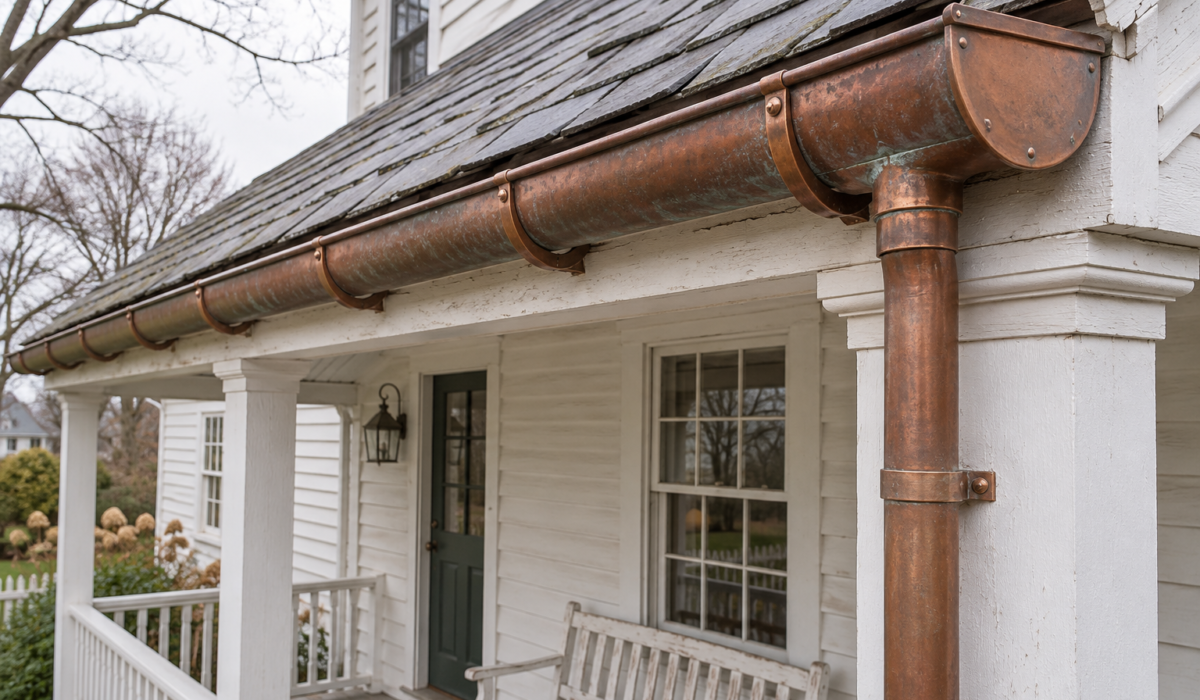
A half-round gutter is easiest to recognize from the end. The trough has a curved bottom, and on many porches you can see brackets cradling it from below. From the sidewalk, those brackets make a repeating pattern underneath the eave. A section that sits lower than its neighbors is often easier to spot from the far end of the porch than from directly underneath.
Look at what moved. If one bracket hangs lower but the painted board behind it lines up with the rest of the trim, ask whether the support has bent or worked loose. If the whole corner looks pulled forward, show the contractor the board as well. That board, called the fascia, may need attention before anyone can securely rehang the gutter. A quote that simply says “reattach loose gutter” leaves an important question open: what will the bracket attach to?
Aged copper presents a separate question. A brown surface tells you very little about whether a seam holds water. Take one photo that shows the finish and another that shows the defect. If you like the aged appearance, say so before authorizing removal. It gives the estimator a reason to price a repair that keeps the visible metal.
When does a small repair make sense?
Consider a porch with one leaking end cap above the entry. The rest of the gutter follows the eave, the brackets are secure, and water reaches the downspout without spilling over. In that situation, ask for the end cap and the adjoining metal to be examined first. If the material around the joint is sound, there may be little reason to disturb the other end of the porch.
Now picture a run with a low point in the middle, several previous patches, and water staining behind two brackets. Fixing the loudest drip might make the entry more pleasant while leaving water against the trim. Ask the contractor to show you which pieces can be reused, where support has failed, and what becomes visible only after the trough comes down. Golden Hands describes its gutter repair services for homeowners arranging that inspection.
Follow the downspout all the way to the ground
On a front porch, the most attractive place for a downspout is often beside a post where it blends into the woodwork. The best place for the water to land can be several feet away. Walk the route from the top elbow to the discharge point. Does the pipe empty onto a narrow strip of planting bed, across a walkway, or into an underground connection?
Imagine that the gutter gets replaced and the next storm leaves the same puddle at the foot of the steps. If the downspout still delivers water to that paving stone, a new trough overhead has done exactly what you asked it to do. The puddle needed its own line in the estimate. Ask where water will go once it leaves the pipe and whether the proposed route interferes with a gate, a porch stair, or the path you use to bring groceries inside.
If the downspout disappears into the ground, tell the contractor what you have actually seen during rain. “Water comes back up around this connection” is more useful than guessing where the buried line ends. It also gives you a clear basis for asking whether checking the underground drainage is included in the price.
Keep the porch detail that matters from the street
Before choosing replacement parts, stand across the street and take one straight-on photograph. Which detail catches your eye? It might be the dark, slender line under the roof, the curved brackets against white paint, or the round pipe tucked against a post. Identify that feature on the photo. A request to “match the old gutters” is easy for two people to interpret differently.
For a Greenport Village property, check the historic district map before committing to a different profile, mounting arrangement, or downspout location. The Village of Greenport Historic Preservation Commission provides the map, application materials, and the relevant village code. Give the village your address and describe the actual scope. Refastening an existing section and changing the appearance of the entire front eave are different proposals. A street-view photo and a sketch of the proposed change make it easier to ask what review applies.
Compare two estimates for the same porch
A price per foot is a poor starting point when one contractor plans to reuse the brackets and another plans to take everything down. Give both the same picture of the porch and ask them to mark the section covered by the price. Then compare four particulars:
Existing metal. Which runs, end caps, outlets, and downspouts will stay? If one damaged section is being replaced, where will the new work meet the old?
Support and trim. Does the price include removing and resetting brackets? If damaged fascia is uncovered, how will the extra work be measured and approved?
Appearance. Which material, profile, and finish will you see from the sidewalk? Ask to see the proposed bracket as well as a gutter sample.
Drainage. Where will the downspout empty, and how will the installer check the repaired run before leaving?
Keep the estimate alongside your photo. When the work is finished, you will have a straightforward way to check the agreed details, right down to the location of the outlet beside the steps.
Arrange a gutter inspection in Greenport
If a half-round gutter is dripping over your Greenport entry, call Golden Hands Construction at (631) 877-8338. Start with the detail that affects how you use the porch: “The seam above the handrail drips even in light rain,” or “The gutter drains, but the bottom step floods.” Share one wide photo and, if you have it, a short rain video. That gives the team a specific problem to investigate and a starting point for discussing what can stay. Explore Golden Hands gutter services.