

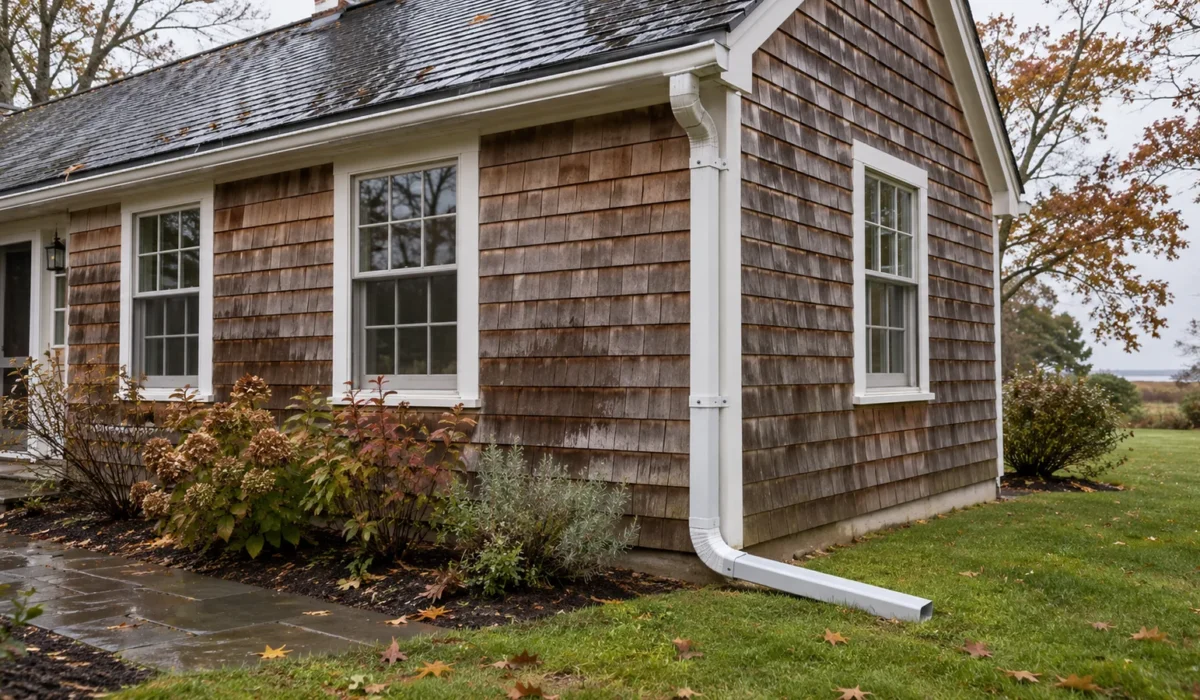
Downspout drainage in Jamesport, NY, is worth checking if rain leaves a puddle next to your house. Before you pay to replace the gutters, find out where the water first leaves the system. Water spilling from the roof edge and a dry downspout outlet can point to a blockage. A steady stream coming out of the pipe and running back toward the house points to a problem at ground level. The two can leave a puddle in the same place, even though they call for different fixes.
Start with the first place you see water
During ordinary rain, look through a window or from a sheltered spot at ground level. Start where you usually see the puddle and trace the water back uphill. Look at the gutter above it, the joints where the downspout bends, and the ground around the outlet. Note whether the problem starts as soon as it rains or only when the rain gets heavier. Then look at another outlet on the same side of the house. A photo of each outlet during the same storm gives you a comparison you can show a contractor.
Check the same corner after the rain ends. A narrow groove in mulch can show where an outlet sends water every time it rains. A wet stripe down the siding can help you spot a joint that leaks partway down. A puddle that sits beside a basement window after the rest of the yard drains is worth documenting, especially if the inside wall gets damp after the same storms. Keep those observations together so you can tell whether the signs tend to appear at the same time.
Water spills over the gutter and little comes out below
When a gutter spills over near one corner and the outlet below barely drips, leaves or shingle grit may be blocking the opening into the downspout. Debris can also catch in one of the bends. A low spot in the gutter can hold water and cause it to spill before it reaches the outlet. The location of the spill helps narrow the check. If water spills in the middle of the run or the edge looks bowed from the ground, the gutter slope and the brackets that hold it deserve a closer look.
Cleaning makes sense when debris is the first thing found. A flow test afterward can show whether water reaches the outlet and exits freely. If the same spot keeps overflowing once the system is clear, the next checks are the gutter slope, the outlet opening, and how much roof drains into that section. A roof valley can send water to one small area faster than the gutter can carry it away. Debris removal is covered under Golden Hands Construction’s gutter cleaning services.
The downspout leaks at a bend or joint
A downspout can still release water at the bottom while leaking higher up. Look for a drip or spray that starts at an elbow or where two pieces meet. A loose strap can let a pipe shift and pull at the joint. A damaged bend can also restrict flow and make water spill from a seam above it. If the drip appears after the gutter fills, checking the outlet and lower bends can help explain why the joint leaked in the first place.
A single split elbow or loose connection often calls for a repair to that part when the surrounding pieces are sound. If the pipe is crushed in several places, pulls away from the wall, or separates at multiple joints, replacing that downspout may be more practical. The condition of the board behind the gutter also matters. A bracket needs solid material to hold it. If the board is soft, fixing the support is part of getting the gutter back into position.
The outlet runs freely and water comes back toward the house
Watch what happens after the stream leaves the pipe. A short extension may send water to a dip next to the foundation. A lawn can slope back toward the house, or a path can send water sideways until it collects by a step or basement window. Moving the end of the pipe can help if it reaches ground where water continues away from the house. Walk the route after rain to see where water settles. The best outlet location depends on the slope and where runoff can go without causing trouble at a walkway or property line.
For a Jamesport home with a narrow side yard, an extension toward the lawn may be easier to place at the back of the house than beside a shared driveway. A wider yard may give runoff more room to spread. The EPA describes how a suitable planted area can absorb roof runoff in its guide to redirecting downspouts. If the lot leaves few options for a discharge point, the Town of Riverhead lists its Engineering Department as the contact for drainage questions on its stormwater management page.
The downspout disappears into a buried pipe
If a downspout feeds a buried line and the joint at ground level backs up, the restriction may be farther along the line. Tell the contractor whether you know where it ends and whether the outlet usually flows. Older photos of the yard or notes from a previous drainage job can help locate it. It helps to know if the trouble began after a patio, planting bed, or walkway was added. The order of those changes gives the contractor somewhere to start looking.
A contractor can assess the above-ground section and explain whether the buried line or the yard slope needs a separate check. When a homeowner sees water at the basement wall, the source can also involve grading or other moisture paths. The EPA includes roof drains and the landscape around the house in its building moisture control guidance.
What a gutter estimate should explain
A written estimate should identify the problem area, the work proposed, and where water will go once the job is done. For a small fix, it may describe clearing an outlet, replacing an elbow, or adjusting a section of gutter. If a larger gutter or an added outlet is proposed, ask how much roof feeds the existing run and where the extra water will discharge. If the estimate includes a buried drain or repairs to the board behind the gutter, ask for those items to be listed clearly so you can compare the scope of the work. See the kinds of work covered by Golden Hands Construction’s gutter repair services.
Access and the condition of nearby materials can affect the price. A second-story corner over a porch may take more setup than a downspout on a one-story garage. A straightforward pipe repair may also grow in scope if the gutter supports or the wood behind them are damaged. If you are given two options, ask what each one fixes and how the contractor will check that water is flowing to the intended spot when the work is finished.
Common questions about downspout drainage
Can I use a splash block instead of an extension?
A splash block spreads water and reduces the force of the stream where it lands. It can work where the ground already slopes away and the block reaches far enough to direct the flow. An extension is often a better fit when water must cross a planting bed or reach ground that sits farther from the wall. Look at where the stream ends after it leaves the block.
Can gutter guards solve repeated overflow?
Guards can keep some leaves out of a gutter, which can help when leaves are the main problem. A clogged downspout, a low gutter section, or an outlet that sends water back toward the foundation each needs its own fix. If you already have guards, note whether water spills at one corner or along a wide section of roof. That observation helps decide where to check first.
Get the water flowing away from your Jamesport home
If the same corner of your Jamesport home keeps flooding after rain, contact Golden Hands Construction Inc for a gutter assessment. Call (631) 877-8338 or email in**@***********ny.com. Share a photo of the gutter, downspout outlet, and puddle if you have one. It gives the team a clearer place to start when checking where the water is going.


