

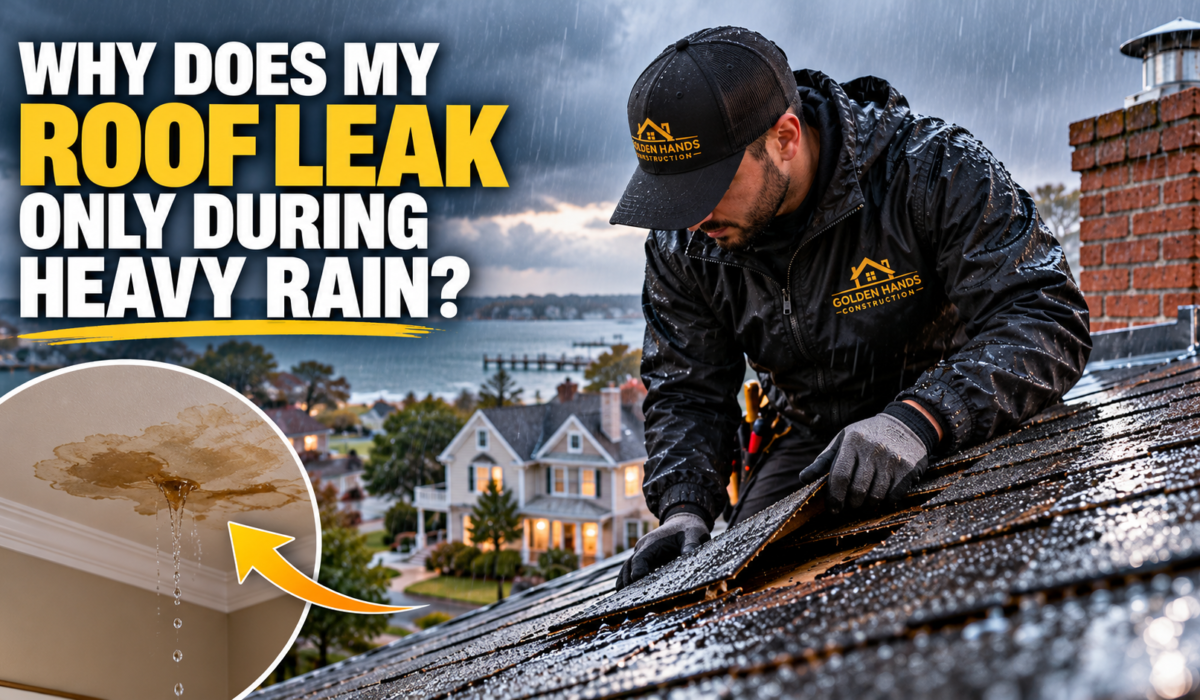
Your roof stays dry during light rain.
Then a heavy Long Island downpour arrives and suddenly there is a wet spot on the ceiling.
A few hours later, the rain stops.
The leak disappears.
It is easy to assume the problem was unusual weather and forget about it.
That can be a costly mistake.
A roof that leaks only during heavy rain usually has a weakness somewhere in the roofing system. Stronger rainfall, wind-driven water, or larger amounts of runoff may simply be exposing a problem that lighter rain cannot reach.
If you live on Long Island and your roof leaks only during severe rain, here are seven possible causes worth investigating.
1. Wind-Driven Rain Is Getting Under Your Shingles
Rain does not always fall straight down.
During a strong coastal storm, wind can push rain sideways and underneath roofing components that normally keep ordinary rainfall out.
FEMA notes that wind-driven rain can enter buildings through damaged roof coverings, roof ventilation components, soffits, windows, and other parts of the building envelope.
Read FEMA’s guidance on wind-driven rain and residential roofs.
This helps explain a frustrating situation many homeowners experience:
Your roof does not leak during a gentle all-day rain.
But when rain arrives with strong wind, water suddenly appears inside.
Potential vulnerable areas include:
Lifted shingles
Damaged shingle seals
Roof edges
Ridge areas
Roof vents
Flashing
Valleys
Roof-to-wall intersections
If your leak only appears during windy storms, tell the contractor exactly that.
It can help narrow down where water is entering.
Golden Hands Construction provides roof repair services on Long Island for leaks and damaged roofing systems throughout Suffolk County, Nassau County, the Hamptons, Riverhead, Montauk, and surrounding areas.
2. Your Roof Flashing Has a Small Gap
Flashing is one of the first places worth checking when a roof leaks only during intense rain.
Roof flashing is typically installed around areas where the roof meets another structure or changes direction.
Common flashing locations include:
Chimneys
Skylights
Dormers
Valleys
Walls
Roof penetrations
Plumbing vents
The purpose is to direct water away from vulnerable joints.
But flashing can become:
Loose
Bent
Corroded
Improperly sealed
Separated from surrounding materials
Damaged by storms
A tiny opening might handle ordinary rainfall without a noticeable problem.
Then heavy rain produces enough water to overwhelm the area.
The result can be a leak that appears only during the strongest storms.
Golden Hands has a dedicated roof flashing service for Long Island homeowners experiencing these types of problems.
3. The Leak Is Coming From Your Chimney Area
A ceiling stain near a chimney does not automatically mean the chimney itself is leaking.
There are several possible entry points around a chimney.
Water may enter through:
Chimney flashing
Counter flashing
Cracked masonry
Crown deterioration
Chimney cap problems
Roof shingles surrounding the chimney
During heavy rain, large amounts of water travel down the roof surface.
If flashing around the chimney has even a relatively small failure, water may enter where the roof and chimney meet.
This is why continuously applying sealant around a chimney does not always solve the problem.
The actual entry point needs to be identified.
If staining consistently appears near your chimney after strong rain, the roof-to-chimney connection deserves close inspection.
4. Your Skylight May Not Actually Be the Problem
Water appears around your skylight.
So naturally, you assume the skylight is leaking.
Sometimes it is.
But sometimes the water entered the roof above the skylight, traveled underneath roofing materials, and finally became visible around the skylight opening.
Possible causes include:
Failed skylight flashing
Damaged shingles above the skylight
Deteriorated seals
Improper installation
Blocked drainage paths
Roofing deterioration nearby
Golden Hands has a dedicated skylight leak service that focuses on identifying where the water is actually entering rather than simply covering the visible area with sealant.
That distinction matters.
Where you see water is not necessarily where the leak begins.
5. A Roof Valley Is Handling More Water Than the Damaged Area Can Withstand
Roof valleys are the channels created where two sloped roof sections meet.
During rain, water from both roof surfaces can be directed toward the valley.
That means a valley may carry a significant amount of runoff during heavy rainfall.
If there is:
Damaged flashing
Deteriorated shingles
Improper installation
Debris buildup
Worn underlayment
the valley may remain dry during lighter rainfall but begin leaking when the volume of water increases.
This is one reason some roof leaks appear only during severe storms.
The issue is not necessarily that heavy rain is somehow penetrating a perfectly healthy roof.
The heavy rain may simply be exposing a weakness that was already there.
6. Your Gutters Are Backing Water Up Near the Roof
Sometimes the roofing material itself is not the only problem.
Your drainage system can contribute.
When gutters become clogged with:
Leaves
Pine needles
Twigs
Roof granules
Dirt
Storm debris
they may not move water away from the roof efficiently.
Heavy rain can then cause gutters to overflow.
Depending on the roof and gutter configuration, this can contribute to water problems around:
Fascia
Soffits
Roof edges
Exterior walls
This issue becomes especially relevant on Long Island during fall, when leaves and storm debris can accumulate quickly.
Golden Hands provides gutter services on Long Island for homeowners dealing with damaged or poorly functioning drainage systems.
If the roof leak appears during heavy rain and your gutters are simultaneously overflowing, the two problems may be connected.
7. Your Roof Underlayment May No Longer Be Providing Enough Protection
Shingles are the part of your roofing system you see.
But they are not the only layer protecting your home.
Underneath the roof covering is an underlayment designed to provide additional protection.
FEMA explains that when roof coverings become damaged, wind-driven rain can get underneath shingles and reach the underlying roof materials. Upgraded or properly functioning underlayment can provide an important secondary water barrier.
Read FEMA’s guidance on sloped roof systems and underlayment.
On an aging or damaged roof, underlayment may also have deteriorated.
Once water gets beneath the shingles, there may be little stopping it from reaching:
Roof decking
Rafters
Insulation
Ceilings
This can be one reason an older roof begins leaking more frequently during severe rainfall.
Why Can’t I Find the Leak When It’s Dry?
Roof leaks are often difficult to diagnose because water moves.
The place where you see a stain inside your home may be several feet away from the actual roof penetration.
Water can travel along:
Roof decking
Rafters
Nails
Pipes
Insulation
Framing
before finally dripping onto the ceiling below.
For example:
A flashing failure near a chimney may allow water inside.
The water travels along a rafter.
It finally drips onto the ceiling six feet away.
The homeowner sees the ceiling stain and assumes the roof directly above it is damaged.
The repair gets made in the wrong place.
Then the next storm arrives.
The leak comes back.
That is why leak diagnosis matters just as much as the actual repair.
Does a Roof Leak Mean You Need a New Roof?
No.
One leak does not automatically mean your entire roof needs replacement.
Many roof leaks can be repaired when the cause is isolated.
A roof repair may make sense when:
Only a small section is damaged
Flashing is responsible
A few shingles are compromised
The roof otherwise remains in good condition
The leak has a clearly identifiable source
However, replacement may become more reasonable when:
Leaks are appearing in multiple areas
The roof is extensively deteriorated
Previous repairs repeatedly fail
Large sections of shingles are damaged
Roof decking has widespread moisture damage
Repair costs continue accumulating
The correct decision starts with finding out what is actually wrong.
Golden Hands offers professional roof inspections that can help determine whether a localized repair is enough or whether broader deterioration is present.
Why You Shouldn’t Ignore a Small Roof Leak
A small water stain can feel harmless.
After all, maybe only a few drops entered.
But roof leaks usually involve more than the visible stain.
Moisture may affect:
Insulation
Roof decking
Rafters
Drywall
Paint
Interior finishes
The longer the entry point remains open, the more opportunities future storms have to send water through it.
A leak that appears only once during an unusually severe rainstorm still deserves investigation.
The storm may have revealed the problem.
It did not necessarily create it.
What Should You Do When Your Roof Starts Leaking During Heavy Rain?
First, protect the interior of your house.
Place a container beneath an active drip if necessary and move furniture or valuables away from the affected area.
Then document what is happening.
Take pictures of:
Ceiling stains
Active drips
Wet attic areas
Exterior roof damage visible from the ground
Also make a note of the weather conditions.
Was there:
Heavy rainfall?
Strong wind?
Rain blowing from one direction?
An overflowing gutter?
Water around a chimney?
Water around a skylight?
Those details can help a roofer diagnose the problem.
Most importantly, do not climb onto a wet roof yourself.
Roof surfaces can become extremely slippery during and immediately after rain.
Wait for safe conditions and have the roof evaluated professionally.
When Should You Call a Long Island Roofer?
You should consider scheduling an inspection if:
A ceiling stain appears after heavy rain
The same leak keeps returning
Your attic becomes damp
Water appears around a chimney
Your skylight leaks during storms
Shingles are visibly lifted or missing
Gutters overflow badly during rainfall
You smell persistent dampness indoors
Previous leak repairs have not worked
The objective should not simply be:
“Stop the water I can see.”
It should be:
“Find where the water is entering and fix the cause.”
That difference can prevent the same leak from returning after the next Long Island storm.
A Roof Shouldn’t Leak Just Because the Rain Is Heavy
Heavy rainfall can be demanding on any roofing system.
But a properly functioning roof should be designed to keep water outside.
If your house remains dry during light rainfall but leaks whenever Long Island gets a strong storm, consider it a warning.
There may be a vulnerable shingle, failed flashing, valley problem, skylight issue, chimney connection, drainage problem, or deterioration underneath the visible roof covering.
Finding that weakness now may be much easier than dealing with extensive interior water damage later.
Golden Hands Construction provides roofing services throughout Long Island, Suffolk County, Nassau County, Southampton, Riverhead, Montauk, the Hamptons, and surrounding areas. The company’s current website lists roof repair, roof inspection, flashing, gutter, skylight, chimney, and other exterior services for Long Island homeowners.
If your roof has started leaking during heavy rain, don’t wait for the next storm to test it again.
Request a free estimate from Golden Hands Construction or call (631) 877-8338.


