

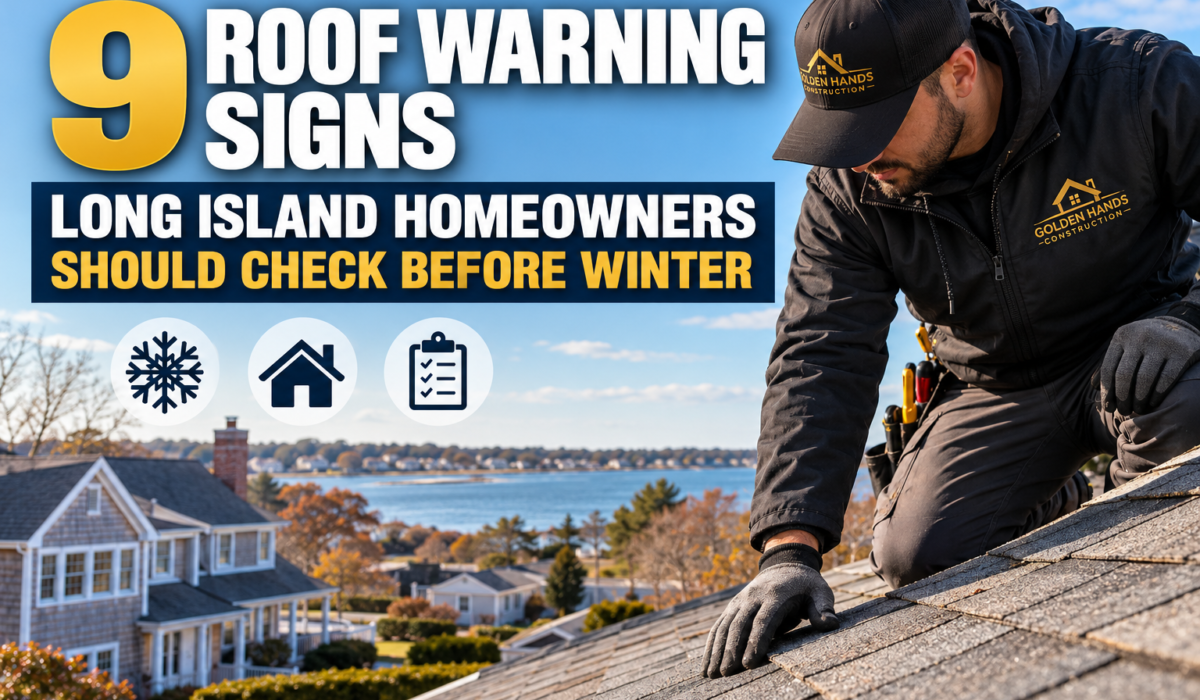
A Long Island roof can look perfectly normal from the driveway while problems are developing underneath the shingles, around flashing, inside the attic, or along the roof edges.
That becomes especially important heading into winter.
Wind, heavy rain, freezing temperatures, snow, and repeated freeze-thaw cycles can turn a small roofing weakness into a leak that damages insulation, ceilings, walls, or roof decking.
The good news is that many roofing problems give homeowners warning signs before they become emergencies.
If you own a home in Suffolk County, Nassau County, the Hamptons, Southampton, Riverhead, Montauk, or elsewhere on Long Island, here are nine roof warning signs worth checking before winter weather arrives.
1. You Have Missing, Loose, Cracked, or Curling Shingles
Start with one of the easiest things to notice.
Stand safely on the ground and look at your roof from several angles. You do not need to climb onto the roof yourself.
Look for:
Missing shingles
Shingles that appear lifted
Cracked shingles
Curling or buckling edges
Sections that look different from the surrounding roof
Exposed areas where shingles may have blown away
A few damaged shingles might appear minor, but the roofing system underneath them is now more exposed to rain, melting snow, and wind-driven moisture.
Long Island also experiences strong coastal weather. Wind damage can sometimes loosen roofing materials without immediately causing a visible interior leak.
If you notice damaged shingles, having them evaluated through a professional roof repair inspection from Golden Hands Construction before winter may prevent a much larger repair later.
2. You See Water Stains on Your Ceiling or Walls
A brown, yellow, or dark ring on a ceiling should never be ignored.
The stain may seem dry today, but it usually means moisture has entered the building at some point.
One frustrating part of roof leaks is that the visible stain is not always directly underneath the place where water entered.
Water can travel along:
Roof decking
Rafters
Insulation
Pipes
Framing
Ceiling materials
before becoming visible inside the house.
That is why simply painting over a stain does not solve the underlying problem.
If the stain becomes larger after rain, feels damp, or appears close to a chimney, skylight, vent, valley, or exterior wall, schedule a professional roof inspection.
Finding the actual entry point is more important than covering the evidence it left behind.
3. Your Attic Smells Musty or Shows Signs of Moisture
Some roof problems appear inside the attic before they appear in your living room.
If the attic is safely accessible, look for:
Damp insulation
Dark staining on roof decking
Moist rafters
Water marks
Rust around fasteners
Mold-like growth
A persistent musty smell
Daylight visible through unexpected gaps
The U.S. Department of Energy notes that attic moisture can be associated with roof leaks, flashing problems, ventilation issues, and other sources of moisture intrusion.
Their guidance also identifies wet insulation, warped wood, mildew, and deteriorating roof-edge materials as potential signs that moisture is entering an attic.
Read the U.S. Department of Energy guidance on durable attics and moisture problems.
Do not assume attic moisture automatically means the entire roof needs replacement. The source needs to be identified first.
Sometimes the correct solution is localized repair. Other times widespread deterioration means replacement becomes the more economical long-term decision.
4. Flashing Around Your Chimney, Skylight, or Roof Penetrations Looks Damaged
Many roof leaks do not begin in the middle of a large shingle field.
They begin where the roofing system changes direction or meets another structure.
Important areas include:
Chimneys
Skylights
Plumbing vents
Roof valleys
Dormers
Walls
Roof-to-wall intersections
Exhaust vents
These locations often rely on flashing to redirect water away from vulnerable joints.
If flashing becomes loose, corroded, displaced, cracked, or improperly sealed, water may find a route underneath the roof covering.
Golden Hands provides dedicated roof flashing services on Long Island as well as skylight repair services for homeowners experiencing problems around these penetrations.
One especially useful clue is a leak that appears only during certain wind directions or particularly heavy storms. Wind-driven rain can expose weaknesses that ordinary rainfall does not.
5. Your Gutters Are Overflowing or Water Is Collecting Near the Roof Edge
Your gutters and roof work together.
When gutters cannot move water away efficiently, moisture may remain where you do not want it.
Check for:
Overflow during rainfall
Sagging gutter sections
Loose gutters
Heavy debris buildup
Water spilling behind the gutter
Persistent wet areas around fascia
Downspouts that are not draining correctly
Clogged or damaged gutters can contribute to moisture problems around roof edges, fascia, soffits, and exterior walls.
Before winter, it is worth making sure the drainage system is functioning correctly rather than waiting for freezing weather to expose the problem.
Golden Hands also provides gutter services for Long Island homes when repairs or additional work are needed.
6. You Had Roof Problems During Last Winter but Never Fixed the Cause
This is one of the most important signs on the entire list.
Think back to last winter.
Did you notice:
Icicles forming repeatedly along the roof edge?
Water stains after snow?
Damp attic insulation?
Leaks that disappeared once temperatures increased?
Ice buildup near gutters?
Water entering around skylights or exterior walls?
If so, the problem may return.
Ice dams can form when snow melts on a warmer portion of a roof and then refreezes near a colder roof edge.
The U.S. Department of Energy explains that water accumulating behind an ice dam can work underneath roofing materials and eventually leak into an attic.
See the Department of Energy explanation of ice dams and roof-edge protection.
FEMA’s snow-load guidance also explains that ice dams can contribute to water infiltration and uneven snow and ice accumulation on roofs.
Read FEMA’s Snow Load Safety Guide.
The solution is not necessarily to attack ice from the outside every winter.
Roofing, insulation, air sealing, ventilation, drainage, and roof-edge protection can all play a role depending on the house.
The underlying cause should be diagnosed rather than treating only the visible ice.
7. Your Roofline Appears to Sag
A roof should generally appear straight and structurally consistent.
If you notice an area that visibly dips, waves, or sags, arrange an inspection rather than waiting until winter.
Possible causes vary and cannot be diagnosed accurately from the ground alone.
Moisture-damaged roof decking, structural movement, deteriorated materials, or other conditions may be involved.
This is also one situation where DIY investigation is a bad idea.
Do not climb onto a roof that you suspect may have structural problems.
A professional can examine the roof system and determine whether the problem is limited to roofing materials or whether additional structural evaluation is necessary.
8. The Same Part of Your Roof Keeps Leaking
If somebody has “fixed” the same leak two or three times and it keeps returning, that tells you something important.
The visible leak might not be the real problem.
For example, repeated water entry can sometimes originate from:
Incorrectly installed flashing
A valley problem
Deteriorated underlayment
A skylight installation issue
Multiple damaged shingles
A chimney-related issue
Widespread roof deterioration
Repeatedly applying sealant to the visible area may only postpone the next leak.
This is where a broader inspection becomes valuable.
Golden Hands Construction’s Long Island roof repair service is designed to identify the damaged area before determining the appropriate repair.
The goal should be to fix the source—not simply make the symptom disappear until the next storm.
9. Repairs Are Becoming More Frequent Across an Aging Roof
There is a point where repairing one isolated problem makes sense.
There is also a point where continually paying to repair different sections of the same deteriorating roof stops making financial sense.
Consider the bigger picture.
If you have had multiple repairs in different areas, visible widespread deterioration, continuing leaks, damaged decking, or significant roofing material failure, ask whether repairing another small section is really the best investment.
That does not mean every older roof should automatically be replaced.
A professional inspection should determine the condition first.
But when problems are no longer isolated, comparing the cost and expected lifespan of another repair against a complete roof replacement on Long Island can help homeowners make a better decision.
Roof Repair or Roof Replacement: How Do You Decide?
There is no responsible answer based only on roof age.
The decision depends on the actual condition of the roofing system.
A repair may make sense when:
Damage is localized
Most roofing materials remain in good condition
Flashing is the primary problem
Only a small number of shingles are damaged
The roof has substantial useful life remaining
Replacement may deserve consideration when:
Problems occur throughout multiple roof areas
Leaks repeatedly return
Roofing materials are extensively deteriorated
The underlying decking has significant damage
Repair costs are repeatedly accumulating
The existing roof system can no longer reliably protect the house
The best starting point is therefore not asking:
“Do I need a new roof?”
It is asking:
“What condition is my roof actually in?”
That is what a proper inspection should establish.
Why Checking Your Roof Before Winter Matters on Long Island
Long Island homes are exposed to a combination of coastal winds, heavy rain, winter freezes, snow, and occasional powerful storms.
Waiting until water is actively entering your house removes many of your options.
A small damaged area discovered during an inspection may be relatively straightforward to repair.
The same weakness discovered after repeated water infiltration can involve insulation, drywall, sheathing, framing, paint, or interior finishes.
There is another advantage to checking early: you can make a decision without an emergency forcing you into one.
You have time to:
Understand what is damaged
Compare repair and replacement options
Ask questions
Review materials
Plan the project
Prepare the roof before harsher weather
That is much better than discovering a major leak during a winter storm.
A 5-Minute Pre-Winter Roof Check You Can Do From the Ground
You do not have to climb onto your roof.
Walk around your property and check these items safely from ground level:
Look up: Are shingles missing, lifted, curled, or visibly damaged?
Look at the edges: Do fascia, soffits, or gutters appear loose, stained, or deteriorated?
Look inside: Are there unexplained ceiling stains?
Check the attic: If safely accessible, are insulation or roof decking damp?
Think about previous storms: Did you have leaks last winter that were never professionally diagnosed?
Look around chimneys and skylights: Can you see obvious displacement or deterioration?
Watch during the next rainfall: Are gutters overflowing or is water behaving differently than expected?
If something looks suspicious, avoid walking on the roof yourself.
A roofing contractor can inspect areas that cannot safely be evaluated from the ground.
Don’t Wait for the First Winter Leak
A roof usually gives some warning before a serious failure.
The challenge is recognizing those warnings early enough to do something about them.
Missing shingles, recurring leaks, ceiling stains, attic moisture, damaged flashing, gutter problems, ice-dam history, sagging areas, and repeated repairs all deserve attention before Long Island enters the harshest part of winter.
Golden Hands Construction provides roofing services throughout Long Island, including Suffolk County, Nassau County, Southampton, Riverhead, Montauk, the Hamptons, and surrounding communities.
If you are unsure whether your roof needs a small repair, a more detailed inspection, or replacement, start with an evaluation rather than guessing.
Request a free estimate from Golden Hands Construction or call (631) 877-8338.


