

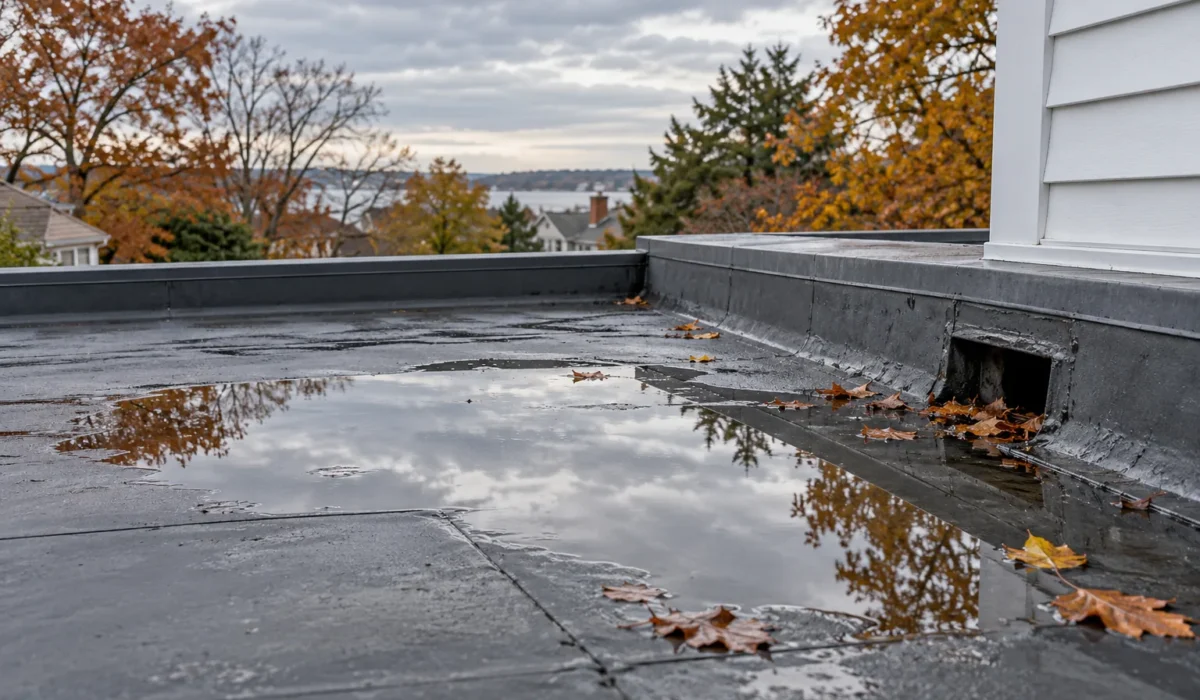
Standing water on a flat roof after rain can point to a blocked outlet, a low area or a drainage layout that needs attention. A shallow puddle shortly after a storm does not automatically mean the roof has failed. However, water that repeatedly remains in the same place deserves an inspection, even when the ceiling below looks dry.
The useful questions concern how long the water stays, where it collects and whether the pattern has changed. A puddle beside a blocked drain presents a different problem from water trapped in a depression far from an outlet.
For Long Island homeowners with low-slope additions, garages or other flat-roof sections, the goal is to identify why the water remains before paying for a patch, coating or replacement.
How long should water remain on a flat roof?
The term “flat roof” usually describes a low-slope roof rather than a surface intended to hold water. The roof needs a drainage route suited to its assembly.
GAF’s technical bulletin on ponding water on TPO and PVC membranes defines ponding as water that has not drained or dissipated within 48 hours after precipitation ends. That definition applies to the bulletin’s context; it is not a universal guarantee that every puddle is harmless before that point. gaf.com
Record when the rain stops and photograph the area later from a safe, accessible viewpoint. If rain begins again, note that too. A sequence of photographs gives the roofer more useful information than one image taken during a storm.
Do not wait for a time threshold if you notice an active leak, a new depression or other signs of distress.
A blocked outlet may interrupt the drainage route
Leaves, twigs and debris can collect around drains, scuppers and gutter connections. A scupper is an opening that allows water to leave through a roof’s perimeter wall.
When an outlet becomes restricted, water may collect upstream instead of leaving the roof as intended.
Johns Manville’s roof design and maintenance guidance identifies drainage maintenance as an important part of roof care and explains how debris can impede water flow. Johns Manville
A contractor should check the complete discharge route. Clearing visible leaves at the opening may not resolve a restriction farther along a pipe or downspout.
Ask whether the inspection includes checking where the water ultimately exits. The roof outlet and downstream drainage need to work together.
A low area can hold water even when the drain is clear
Not every puddle comes from a blockage. Water may collect where part of the roof sits lower than the route to the outlet.
The cause needs assessment. A photograph alone cannot establish whether the condition involves the roof surface, insulation, deck or supporting structure.
Tell the contractor whether the puddle has always appeared in that location or developed recently. Mention any equipment installation, repair work or other change to the roof.
Do not assume that filling the depression with a general-purpose product will provide a suitable repair. The proposed approach needs to account for the existing assembly and its condition.
A new or increasing depression deserves prompt professional assessment rather than repeated surface treatment.
Why a roof coating may leave the puddle unchanged
A coating can form part of an appropriate roofing system, but it does not automatically change the slope or move an outlet.
If the underlying problem is poor drainage, a surface treatment may leave water collecting in the same place.
GAF’s liquid-applied roofing manual includes drainage and substrate suitability among the conditions that need attention before coating work proceeds. Product compatibility and preparation also matter. gaf.com
Before accepting a coating proposal, ask what it will accomplish. Will it address a documented membrane defect, form part of a restoration system or change the drainage condition?
Those are different outcomes. The estimate should make the intended result clear.
A dry ceiling does not confirm that the roof needs no work
Standing water and an indoor leak are related concerns, but they are not the same observation.
A roof may retain water without showing an immediate ceiling stain. Conversely, an indoor leak can come from a nearby flashing detail rather than the middle of the visible puddle.
GAF’s ponding-water bulletin identifies potential consequences of persistent water, including additional loading and biological growth. It emphasizes the importance of slope and drainage. gaf.com
An inspection should consider both the drainage pattern and the condition of seams, penetrations and perimeter details.
If you have an indoor stain, photograph its location and note when it becomes wet. That information helps the contractor investigate beyond the visible pool.
What homeowners can record safely
Keep a simple record of when water appears and how long it remains. Note whether the affected area changes after different storms.
Take photographs only from a safe location that does not require accessing the roof. An upper-floor window may provide a useful view, but do not lean out or step onto the roof for a better angle.
Mention any recent work by roofers, equipment installers or other trades. Also record earlier leaks and previous drainage repairs.
Avoid probing the membrane, cutting an outlet or moving heavy objects yourself. Those actions can introduce damage or make the original condition harder to assess.
The most useful homeowner contribution is a clear history, supported by photographs.
What a flat-roof inspection should explain
A useful inspection should identify the roofing material, the drainage route and the condition of the affected area.
The contractor should distinguish confirmed defects from questions that require further investigation. If concealed materials need assessment, ask what access or testing may be necessary.
A roof inspection on Long Island should also explain whether the immediate priority is clearing drainage, repairing a defect or obtaining a broader assessment.
Request photographs that show the outlet, the puddle area and any damage supporting the recommendation.
You should understand why the proposed work fits the observed condition before agreeing to it.
Can ponding water be corrected without replacing the roof?
Sometimes. A restricted outlet may need maintenance, while a local defect may allow a targeted repair.
Other conditions require more involved work. Depending on the roof, a designer or contractor may consider drainage changes or a suitable tapered assembly that directs water toward outlets.
Johns Manville’s reroofing guidance discusses options such as tapered insulation and drainage modifications. These require a design suited to the individual roof. jm.com
There is no single repair that fits every puddle. Ask whether the proposal addresses the cause of the water retention or only a damaged surface.
A flat-roof repair assessment can help establish the practical scope.
What affects the cost of correcting standing water?
Access, roof size, material type and the cause of the problem all influence the work.
Clearing an accessible outlet differs from altering the drainage layout or removing roofing to assess concealed damage. A project involving wet or deteriorated materials also needs a different scope from a surface repair.
Ask whether the estimate includes drainage work, membrane reinstatement, disposal and any necessary testing.
If hidden damage could change the price, agree on how the contractor will document it and obtain approval.
Comparing written scopes helps you understand why two estimates differ. The cheapest proposal may cover less work, while a larger proposal should explain why that work is necessary.
Common questions about standing water on flat roofs
Does every puddle mean the roof needs replacement?
No. The cause, duration and condition of the roof matter. A local drainage restriction does not automatically justify replacing the entire assembly.
Should I sweep the water toward the drain?
Avoid accessing the roof or attempting to move the water yourself. Wet roofing presents a slip hazard, and unsuitable tools can damage the surface. Arrange an assessment of why the water remains.
Will adding another drain solve the problem?
A new outlet may form part of a suitable design, but its location, connection and discharge route need consideration. Adding an opening without assessing the roof can introduce another defect.
Can I ignore a puddle that disappears eventually?
Record the pattern and discuss recurring water with a roofer. The fact that it eventually evaporates does not explain whether the drainage performs as intended.
Address the drainage problem before choosing a treatment
Standing water on a flat roof after rain needs an explanation before it needs a product. The right next step depends on whether the cause involves maintenance, the roof surface, the drainage layout or underlying materials.
Golden Hands Construction Inc provides flat-roof repair services on Long Island. Request an inspection and estimate or call (631) 877-8338. Share photographs and explain how long the water remains so the assessment can focus on the drainage problem.


